What is qualification for laser vision correction surgery?

When you come to Blikpol, you will first be greeted by a friendly registration staff and explained exactly what your visit will consist of. You will also fill out the necessary documents. Then you will be attended to by a doctor who will conduct a thorough interview and examine your eyesight
We won’t bore you with a list of studies, but we will say that:
- Qualification tests at Blikpol are very thorough and last up to 2h
- Of course, throughout this time we will not tire you out with measurements. In between entering the office, you will also spend some time in the waiting room while your pupils react to the drops given by the doctor.
- An optometrist will take some of the measurements, but – unlike at other centers – you will spend a lot of time with our doctor, who will later correct your visual impairment. This gives our eye surgeons a better chance to get to know you and pick up all the nuances about your defect and expectations.
- A better understanding of your needs can influence subtle changes in the planning of your procedure or influence the choice of method. You also get more time to ask questions of the person who will ultimately take care of your eyes. Meet our team.
Our intention is NOT to treat our patients with tape.
We want you to feel important with us. We want you to feel cared for with us.
In our opinion, one of the absolute most key features of a laser vision correction center is its diagnostic capabilities.
We’ll give you cosmic quality diagnostics, because we think that’s the arch-important part of the procedure. You can read more about our technologies here: click
And once your doctor qualifies you for the procedure, you will be able to have it done the same day in a so-called same-day procedure or set up a convenient date with us. Or, of course, you can come just for a qualifying examination, just to check your eyesight or satisfy your curiosity.
It may also turn out that for various, mainly health reasons, you do not qualify for laser vision correction, and then our ophthalmologist will suggest the best further procedure for you . These may include other types of treatments, such as intraocular or phakic lens implantation, referral for additional tests if he or she diagnoses the disease, or coordinate a treatment plan when needed.
One thing is certain – you will be richer in knowledge about your eyes. You can check the price of the qualification here, and if you decide to have the procedure, it will be free of charge (the amount of the qualification will be deducted from the cost of the procedure – it applies only to the procedure of both eyes). Tests conducted during qualification are valid for 3 months.
If you are over the age of 40 you should be aware of the beginning of aging processes in your organ of vision. You will receive exact information on how loss of lens accommodation (known as presbyopia) will affect your vision after the procedure during qualification. Nevertheless, any person over 40 may need reading glasses over time, just as any person without visual impairment would.
Need more detailed information on what qualifying for laser vision correction looks like?
Qualifying for laser vision correction is a comprehensive process that starts with a phone call, where you will get information on how to properly prepare for such a visit. Do you want to know the different stages of the process?
After making an appointment and reserving 2 hours of your time with us, you undergo a series of detailed examinations to assess whether you are a suitable candidate for a procedure such as laser vision correction.
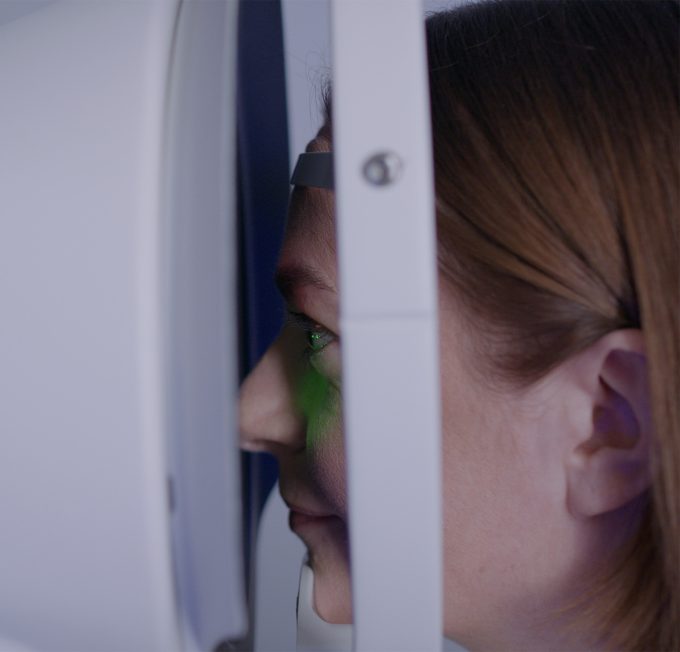
- Computerized eye examination with autokeratorefractometer. This is one of the first and basic examinations to measure a patient’s visual defects (refraction). It allows to determine the degree of defect and its type in an objective way. In addition to refraction, it measures the curvature of the cornea, the top transparent layer of the eye, which has its own power to break the rays entering the eye. The test is non-contact, painless and requires no preparation by the patient.
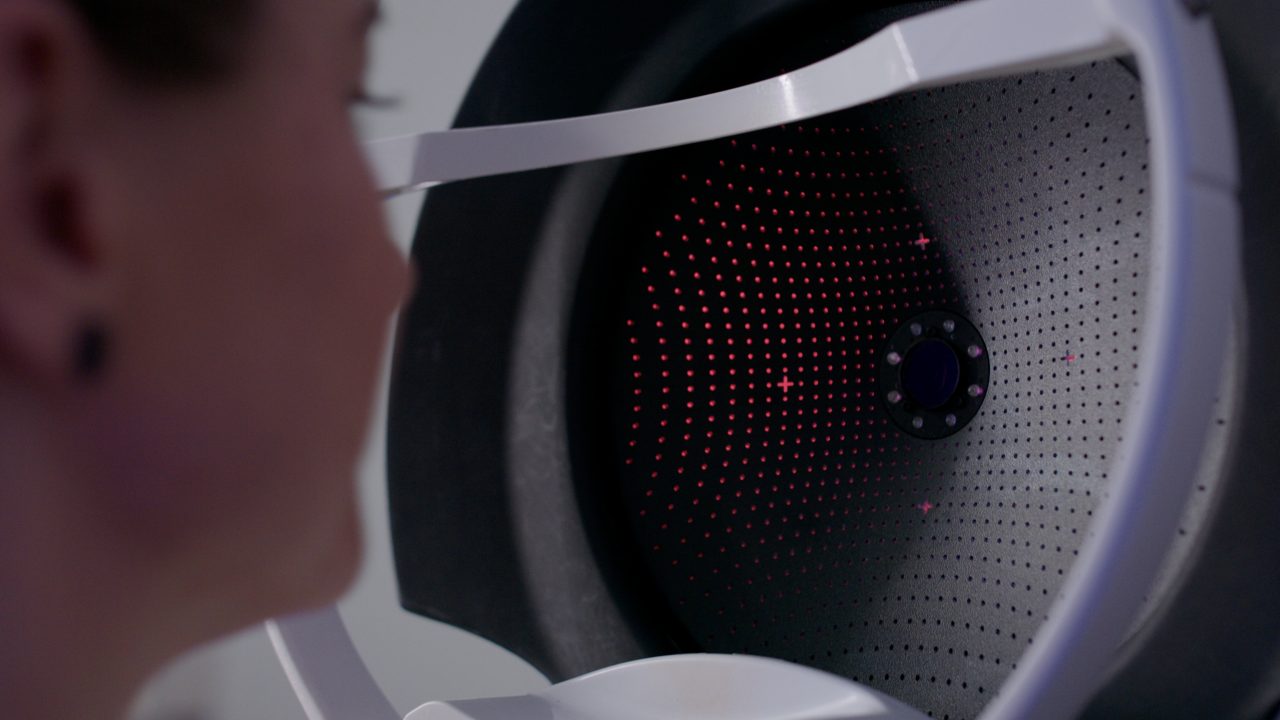
- Topography with Pentacam corneal tomography. It is an advanced diagnostic test that creates a three-dimensional model of the anterior segment of the eye with a rotating Schleimpflug camera, essential when deciding whether laser correction is possible. Accurate measurements of corneal thickness, making topographic and elevation maps of the anterior and posterior parts of the cornea, allow quantitative assessment of the tissue in which the procedure is performed. In addition, they provide information about the density of the lens and its translucency. They also help to get a complete picture of possible corneal dysfunctions or dystrophies, diagnosing the early stages of conditions that are contraindications to surgery, such as corneal conus. The test is very quick and non-contact. For correct results, soft contact lenses should be discontinued two weeks before the examination (for toric or hard lenses, it is 3-4 weeks).
- iDesign Aberrometry. Thanks to the latest aberrometer, which uses the Hartmann-Shack method to measure the refractive defect of the eye, it is possible to map the defect much more accurately, resulting in a more accurately calculated corneal ablation profile during surgery and, consequently, a better quality of vision after surgery. As the only device of its kind on the market, it uses 1257 measurement points (at 7.0 mm pupil) and Fourier analysis to calculate the ablation profile. It also measures pupillometry (pupil width) in scotopic and mesopic conditions so that we can assess the risk of halo formation (clouds around light sources) after correction.
- Intraocular pressure with the AirPuff tonometer. Measurement of intraocular pressure allows us to detect and exclude the risk of glaucoma, which can be a contraindication to surgery. The test is contactless and painless, the patient only feels a blast of air in the eye being tested.
IOL Master Biometry. Otherwise known as an eyeball length study, but it gives us a much higher measurement value, In addition, we will get parameters such as keratometry, which is the power of the cornea in two perpendicular sections, pupil width, iris width (WTW – white-to-white) taken into account when planning the procedure, anterior chamber depth, lens thickness and corneal thickness.- SOCT – spectral optical coherence tomography of the retina, optic nerve and anterior segment of the eye. A diagnostic test that allows obtaining very detailed scans of the structures of the eyeball: cornea including epithelium, iris, lens, angle of the vitreous, vitreous body, retina and optic nerve. The results of the examination are important for assessing the overall health of the eye.
- Slit-lamp examination. This examination allows a detailed evaluation of the front part of the eye, including the cornea, iris and lens, which is essential for assessing the overall health of the eye.
- Examination of the fundus of the eye. Is a key part of the qualification process for laser vision correction. It allows a detailed evaluation of the back of the eye, including the retina, optic nerve and blood vessels, which is essential to detect any abnormalities that may affect the decision to perform laser vision correction.
- Prepare a list of medications taken. The patient should prepare a list of all medications he or she takes on a daily basis, including recent ophthalmic prescriptions. Some medications may affect the healing process after the procedure.
- Important! Pupil-dilating drops. Pupil-dilating drops may be used as part of your exam appointment so the doctor can closely examine the deeper areas of the eye, including the lens and retina. After using the drops during the exam, your vision will be impaired for several, usually up to 4 hours. Do not drive or operate machinery during this time, so take care to get home safely. Also take sunglasses with you on a sunny day, as your pupils won’t respond to the light, and as a result, you will be glaring, and your retina will be more exposed to the adverse effects of UV radiation.
The qualification visit is therefore a key stage that determines the feasibility of the procedure. Based on the information gathered, the doctor is able to determine whether the patient is a good candidate for laser vision correction and which correction techniques will be safest and most effective for the patient. The tests are valid for 3 months. After the expiration date, the tests must be repeated.
What disqualifies for vision correction?
There are various factors that can disqualify a patient from undergoing laser vision correction. These factors are related to both the condition and structure of the eye as well as the patient’s overall health.
- Contact lens wearers. For those who wear contact lenses, a break is required before the qualification tests. Soft spherical contact lenses must not be worn for 2 weeks prior to the examination, as they can alter the shape of the cornea, potentially leading to inaccurate test results and an incorrect assessment of vision. If you wear soft toric lenses (for astigmatism), you should stop wearing them 3 weeks before the examination. For hard contact lenses, an even longer break of 4 weeks is required.
- Keratoconus. This condition causes the cornea to thin and protrude outward, forming a cone-like shape. Keratoconus significantly affects vision quality and is a contraindication for laser vision correction due to the risk of worsening the corneal deformation.
- Herpes. Herpes affecting the eye is an absolute contraindication to the procedure. However, if it affects only the area around the lips, it is a temporary relative contraindication. If the virus in your body has been activated and inflammation is present, the procedure must be postponed until full recovery. If you frequently experience herpes outbreaks, particularly due to stress or a weakened immune system, you may start taking antiviral medications prophylactically a week before the planned procedure to reduce the risk of outbreaks during and after the surgery.
- Breastfeeding. Breastfeeding is not a suitable time for the procedure or for undergoing eye examinations for qualification. Hormonal changes during lactation can affect vision and tear film production, leading to distorted results. It is recommended to attend a qualification appointment 3 months after fully weaning your baby.
- Connective tissue diseases. Conditions such as Marfan syndrome, scleroderma, or keloid formation can affect the stability and elasticity of the cornea, making the procedure riskier.
- Eye diseases. Certain eye conditions, such as advanced dry eye syndrome, active inflammations, or eye infections, increase the risk of complications and are often contraindications for laser vision correction.
- Length of the eyeball. Excessive eyeball length, typical of high degenerative myopia, may disqualify a patient because the effects of the procedure may not be long-lasting and could increase the risk of complications.
- Macular diseases. Diseases affecting the macula, such as macular degeneration, may not provide satisfactory visual improvements even after the correction.
- Dry eye syndrome
Patients suffering from this syndrome may experience worsening symptoms after the procedure, which poses a risk factor. - Autoimmune diseases. These conditions can disqualify a patient from laser vision correction as they impair the body’s ability to heal properly. Autoimmune conditions, such as rheumatoid arthritis or lupus, can lead to unpredictable reactions post-surgery, increasing the risk of complications and affecting the outcome of the correction.
- Qualification for laser vision correction. Thorough exclusion of all contraindications is essential for ensuring the safety and effectiveness of the procedure.
Who does not qualify for laser vision correction?
During the qualification visit before scheduling the laser procedure, an ophthalmologist conducts detailed examinations to determine if the patient is a good candidate. Individuals who do not qualify include those with unstable refractive errors, where changes in vision have occurred in the past year.
Contact lens wearers need a break before the examination to avoid altering the cornea’s shape, but this is not the only disqualifying factor. Keratoconus, a dystrophic protrusion of the cornea, is an absolute contraindication for laser vision correction. During the qualification visit, the doctor also assesses the overall health of the eyes to rule out other potential contraindications, such as active eye diseases or systemic conditions.
What vision impairments qualify for surgery?
Not all vision impairments are eligible for laser vision correction. Procedures such as laser vision correction have their limitations and are not suitable for every type of refractive error. For example, very high refractive errors, both extreme myopia and hyperopia, may exceed the safe correction range of laser methods.
Additionally, individuals with certain specific eye conditions, such as thin corneas or certain retinal diseases, may not be suitable candidates. A comprehensive examination before the planned correction is crucial to assess all aspects of the refractive error and eye health to ensure the safety and effectiveness of the procedure.
Don’t be afraid. The fact that you will come to us for research DOES NOTthat you need to make an appointment for the treatment.