

What do you need to know?
- Laserowa korekcja wzroku to skuteczna metoda leczenia astygmatyzmu, która poprawia jakość widzenia przez zmianę kształtu rogówki.
- Astigmatism manifests as blurred or blurred vision, headaches and eye fatigue, both when looking up close and at a distance.
- Treatment includes wearing glasses, toric lenses or laser treatments that correct the defect permanently.
- See an ophthalmologist when noticing symptoms, avoid contraindications to surgery and follow post-operative instructions for proper recovery.
O laserowej korekcji wzroku słyszał chyba każdy okularnik. Nowoczesne, maksymalnie precyzyjne technologie sprawiają, że coraz więcej osób decyduje się na ten zabieg, zwłaszcza że nie wymaga on nawet pozostawania w szpitalu – cała procedura zamyka się w ciągu jednego dnia. Czy oprócz krótkowzroczności i dalekowzroczności można w ten sposób leczyć również astygmatyzm?
What is astigmatism?
Cornea, lens, retina - how we see
To better understand what astigmatism is, it is helpful to have an understanding of how the human eye works in general. It all starts with light particles, or photons, which bounce off things around us and reach the cornea before entering the eye through the pupil. There, in the lens, the light is refracted and taken up by the retina, which forms an inverted image and then transforms it into a nerve impulse, transmitted via the optic nerve to the brain, which ultimately decides what and how we see.
Corneal deformity
In a healthy eye, the light particles reaching the retina are concentrated at a single point - thus producing a correct image. If, however, there is astigmatism, then the light rays fall on several points simultaneously, resulting in a distorted image. What is the reason for this? The structure of the eye, which normally resembles a round ball, plays a significant role. However, in people with astigmatism, the cornea is not perfectly round, but has a slightly more elliptical shape, such as a rugby ball or an egg. This causes photons to enter the eye through two points and cannot focus on one point on the retina.
Interestingly, astigmatism is a very common abnormality - it affects most people. In many cases, however, the corneal changes are so minimal that the quality of vision is not significantly affected and no correction is required.
Types of astigmatism
Kształt rogówki może być zmieniony na dwa różne sposoby. W zależności od charakteru tego zniekształcenia możemy wyróżnić 2 rodzaje astigmatism:
- If the cornea curves to one side more than the other in a uniform manner, we speak of regular astigmatism, which can be corrected with the help of glasses;
- if the curvature of the cornea is not uniform and irregular across the entire eye surface, we are dealing with irregular astigmatism, which requires the wearing of contact lenses.
In addition to this basic classification, we can also divide astigmatism according to the visual defects with which it usually coexists:
- myopic astigmatism,
- hyperopic astigmatism,
- Mixed astigmatism.
What are the symptoms and causes of astigmatism?
The causes of the corneal changes that cause astigmatism are still not fully recognised and, consequently, this abnormality cannot be prevented. In some cases, this visual defect is congenital, genetically determined, in others, it begins to develop in a few or several years of age. It can also be the result of mechanical damage to the eye.
Blurred image
The most noticeable symptom of astigmatism is impaired vision - the image we see is blurred, smudged or hazy, whether we are looking at something up close or at a distance. This distortion of the image can be more horizontal or vertical - it is affected by the direction of curvature of the cornea.
Headache and tired eyes
Blurred vision is sometimes accompanied by headaches, a feeling of „tension” and eye strain, as well as burning and excessive tearing. These symptoms may occur especially in situations where our eyes are intensely engaged in a particular task for a long period of time: for example, long hours at the computer, watching TV, reading, driving. Often in such cases we involuntarily squint our eyes - it is worth paying attention to this.
Jeżeli dostrzeżemy u siebie lub kogoś bliskiego objawy mogące świadczyć o początkach astygmatyzmu, najlepiej od razu wybrać się do okulisty, który postawi diagnozę i dobierze metodę odpowiednią korekcji. Jest to ważne też z tego względu, że astygmatyzm może być objawem początków innego schorzenia – stożka rogówki, który, jak sama nazwa sugeruje, wiąże się również ze zniekształceniem w obrębie rogówki.
Treatment of astigmatism
Glasses or lenses
The correction of astigmatism usually involves minimising its symptoms - that is, simply fitting suitable spectacles with cylindrical lenses or toric contact lenses. With so-called cylinders, it is possible to correct the angle at which light particles pass through the cornea so that they focus correctly on a single point on the retina. A toric lens, moulded in the right way, performs the same task.
Operative treatment
In addition to these most popular methods, there is a third way to treat astigmatism - surgery. Although it sounds rather serious, in reality it is a procedure which is not burdensome for the patient, but highly effective. Laser vision correction does not just remove the symptoms, but corrects the defect itself, thus preventing the worsening of astigmatism.
LASIK, or laser surgery for astigmatism
In the simplest terms, the LASIK vision correction procedure involves shaping the cornea with a beam of laser beams. This corrects the curvature that contributes to the scattering of light particles and abnormal vision. From the patient's perspective, the operation itself is uncomplicated: it does not require anaesthesia or an extended hospital stay. However, before proceeding with the surgery, a consultation with a specialist is necessary, who, based on several tests, will decide whether we qualify for the procedure.
Qualification for treatment LASIK
Pierwszym krokiem jest wykluczenie wszelkich przeciwwskazań. Do najważniejszych z nich można zaliczyć nieustabilizowaną wadę wzroku (dlatego raczej nie wykonuje się tego typu operacji przed 20 rokiem życia, ponieważ wówczas często mamy do czynienia z wciąż postępującą krótkowzrocznością lub dalekowzrocznością), a także inne choroby oczu, takie jak np. jaskra, zaćma, odwarstwienie siatkówki, stożek rogówki czy dry eye disease. In addition, it is not advisable to carry out laser vision correction if you have diabetes, a pacemaker, rheumatism or severe allergies.
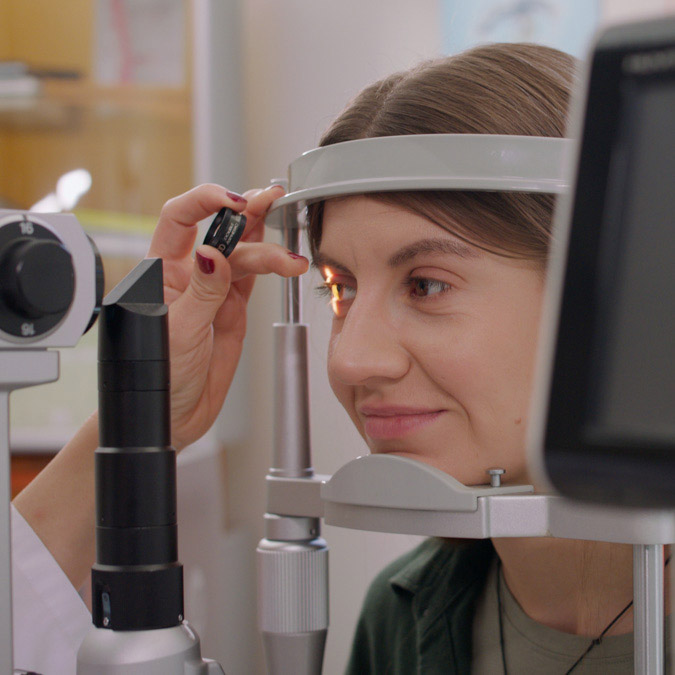
The second key stage is qualification testing. Maximum precision is essential here, which is why at Blikpol we use the latest generation of diagnostic equipment. Qualification for LASIK surgery includes examination of visual acuity, fundus, visual field, corneal topography, as well as measurement of intraocular pressure and ultrasound of the eyeball. Once you know the date of the examinations qualifying you for laser astigmatism surgery, you also need to remember not to wear contact lenses for 2 weeks before your appointment. The same rule applies before the surgery.
What does laser eye surgery look like?
As we have already mentioned, LASIK is a procedure that does not require anaesthesia - so it is only performed under local anaesthesia in the form of eye drops. Once the anaesthetic has taken effect, the actual procedure can proceed. First, a thin flap of the cornea is cut off (or just deflected, depending on the technology chosen). The cornea is then modelled using the laser - minimal patient involvement is also necessary at this point, as the eye should follow the beam of light moving across it. After several minutes at the latest, the corneal flap is placed in the eye again - now all that is left to do is to wait for it to adhere for good.
What range of astigmatism can be corrected by laser?
W ramach laserowej korekcji wzroku możliwe jest wyleczenie astygmatyzmu sięgającego ok. 6 dioptrii. Jeżeli pacjent zmaga się także z krótkowzrocznością lub nadwzrocznością, wówczas taki zabieg umożliwia skorygowanie obu wad (np. astygmatyzmu i krótkowzroczności) równocześnie. W przypadku krótkowzroczności zakres korekcji wynosi aż -13 dioptrii, zaś dalekowzroczność możemy skorygować do ok. +6 dioptrii.
After treatment
Although the operation itself goes quickly and smoothly, it is important to follow rules that promote proper recovery, at least for the first few days afterwards. Therefore, excessive physical exertion and eye strain should be avoided (if possible, it is advisable to temporarily refrain from driving or staring at a screen or monitor for long periods of time - or at least limit it). Sunbathing (both in the sun and in a solarium), hot baths, saunas and swimming pools, as well as applying eye make-up are also inadvisable. Also try to avoid smoky rooms and dust.
It is also very important to be aware of the discomforts that can occur even after a successful procedure. We may feel hypersensitivity to light, slight burning and dryness of the eye. Temporary disturbances in visual acuity may also occur. Such temporary inconveniences are standard and should resolve on their own after a few days or, at the latest, after a few weeks.
Find out more about laser correction of astigmatism HERE.
Ważne pytania i odpowiedzi


